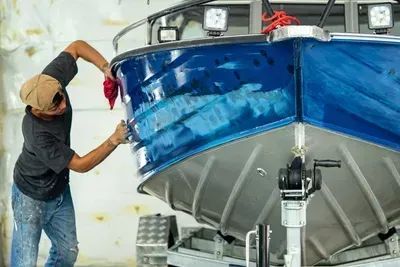
Fiberglass is one of the most widely used composite materials in the world — it's in boats, RVs, sports cars, hot tubs, industrial tanks, and residential fixtures. It's valued for its strength-to-weight ratio, its corrosion resistance, and its ability to be molded into complex shapes. But like any material, it doesn't last forever without maintenance, and understanding how damage occurs is the first step toward repairing it effectively.
How Fiberglass Is Constructed
Before diving into damage, it helps to understand what you're dealing with. Most fiberglass parts consist of several layers. The outermost layer — the one you see and touch — is typically gelcoat, a pigmented resin that serves as a UV barrier and gives the surface its color and gloss. Beneath that is the structural laminate: woven or chopped glass fibers saturated in polyester or vinylester resin and built up to the desired thickness. Some higher-end applications use epoxy resin instead, which offers better adhesion and moisture resistance but comes at a higher material cost.
This layered structure is important because different types of damage affect different layers. A surface scratch that only penetrates the gelcoat is a very different repair from a crack that goes all the way through the laminate — even if both look similar from a distance.
Common Causes of Fiberglass Damage
Impact Damage
Blunt impacts are one of the most common causes of structural fiberglass damage. This includes dock collisions on a boat hull, debris strikes on an RV, or a fender bender on a vehicle with fiberglass body panels. The damage pattern depends heavily on the speed and angle of the impact. Low-speed impacts often result in stress cracks radiating outward from a center point, while higher-speed impacts may cause the material to fracture or even punch through entirely.
A key characteristic of impact damage is that what's visible on the surface often understates how far the damage extends. Delamination — the separation of layers within the laminate — can spread well beyond the obvious crack or chip, and this is something a visual inspection alone won't catch.
UV Degradation
Prolonged sun exposure causes gelcoat to oxidize. The surface turns chalky, loses its gloss, and may develop fine surface crazing — a network of shallow cracks that don't penetrate into the structure but do compromise the appearance and the UV protection that the gelcoat provides. Left unaddressed, UV degradation eventually allows moisture to penetrate into the laminate underneath.
Osmotic Blistering
This issue is most commonly seen in marine applications. Water molecules permeate through the gelcoat over time and reach the laminate below. There, they react with water-soluble compounds in the resin and create small pockets of fluid, which generate osmotic pressure. The result is small blisters, typically between 1 and 20mm in diameter, on the wetted surface of the hull. Blistering is rarely an immediate structural emergency, but in advanced cases it can weaken the laminate if left untreated for years.
Stress Cracking
Fiberglass can develop cracks from repeated flex and vibration, even without a single identifiable impact. This is common in areas that experience regular movement — a boat hull flexing over waves, an RV body flexing over road irregularities, or mounting points that transmit vibration. Stress cracks tend to be fine and numerous, running along the grain of the laminate or in lines parallel to a structural edge.
Improper Previous Repairs
A significant number of repairs we see involve reworking a previous attempt that didn't hold. Common issues include the use of incompatible materials (for example, polyester filler over an epoxy substrate), insufficient surface preparation, failure to remove all contamination before bonding, or simply not addressing the underlying cause of the damage before patching over it. These repairs often look fine initially but fail within months, sometimes causing additional damage in the process.
Repair Approaches
Gelcoat Touch-Up and Refinishing
For damage confined to the gelcoat layer — oxidation, surface scratches, minor crazing — the approach is typically a combination of abrasion, compounding, and either spot application of new gelcoat or a full refinish. Matching gelcoat color is an art as much as a science, since original gelcoat fades and shifts over time, meaning a new application will rarely be an invisible match on older material. On boats and RVs especially, a full section refinish often produces better results than spot repairs because it eliminates the color boundary.
Structural Crack Repair
Cracks that extend into the laminate require more involved work. The standard approach is to grind out the crack in a V-groove pattern to give the repair material a mechanical surface to bond to, then apply successive layers of fiberglass cloth and resin, allowing each to cure before adding the next. The patch must overlap the crack on all sides by a meaningful margin — typically 1 to 2 inches per 1mm of laminate thickness — to restore the structural integrity of the area. Once cured, the repair is faired flush and refinished with gelcoat or paint.
Patch Repairs for Holes or Severe Damage
Large holes or sections with extensive damage require a backing plate or form to support the wet laminate while it cures, since you can't lay up fiberglass in mid-air. Depending on the access available on the back side of the panel, this might mean inserting a removable backing through the hole, or in closed structures, working blind and using specialized techniques to apply backing material from the front only. These repairs are more time-consuming and require a higher skill level than simple crack repairs, but they can fully restore structural integrity when done correctly.
Delamination Repair
When layers within a laminate separate, the repair approach depends on the extent and location of the delamination. Small areas of delamination can sometimes be resin-injected — drilling small holes and injecting low-viscosity resin under pressure to re-saturate the separated layers — which is less invasive and preserves more of the original material. Larger delaminated areas generally need to be cut out and rebuilt with fresh laminate.
What Affects the Durability of a Repair
Surface Preparation
This is the single most important factor in how long a repair lasts. Fiberglass repair materials bond mechanically and chemically to the substrate, and both types of bonding are undermined by contamination. Wax, mold release agents, oil from handling, and chalky oxidized gelcoat all prevent proper adhesion. Adequate preparation means not just sanding, but washing, solvent-wiping, and in many cases testing adhesion before committing to a full repair.
Material Compatibility
Polyester resin, vinylester resin, and epoxy resin have different chemical compatibilities. As a general rule, epoxy will bond to cured polyester, but polyester will not bond reliably to cured epoxy. Using the wrong combination leads to adhesion failure. This is one reason why a repair that looks solid in the shop can start peeling within a season — someone used materials that weren't compatible with the substrate.
Environmental Conditions During Cure
Resin systems have defined working temperature and humidity ranges. Below about 60°F, most polyester resins cure very slowly and incompletely. High humidity can cause amine blush on epoxy surfaces — a waxy residue that prevents inter-coat adhesion. A repair that cures in poor conditions will have compromised physical properties regardless of how well the rest of the work was done.
Addressing the Root Cause
If a crack developed because of a structural flex point, patching the crack without addressing the flex will result in the crack reopening, often faster than the first time. Effective repairs include an assessment of why the damage occurred and, where possible, changes to reduce the stress that caused it — adding a backing plate, reinforcing a mounting point, or adjusting hardware that was transmitting load to an unintended area of the hull or body.
When a Repair Is and Isn't the Right Answer
Not every piece of fiberglass is worth repairing. If the underlying laminate is extensively saturated with water (common in badly blistered boat hulls), the repair process includes drying out the laminate — sometimes over months — before any patching can be effective. For older vehicles or boats where structural integrity has been compromised over a large area, the cost and complexity of a full restoration sometimes outweighs the result, and replacement is the more practical path. A professional assessment that gives you an honest read on the scope of work is worth doing before committing to a repair approach on significant damage.
Have a repair question?
If you're not sure whether your damage is surface-level or structural, reaching out for a consultation is a good first step. We can often give you a preliminary read based on photos before any on-site work is needed.
Get in Touch